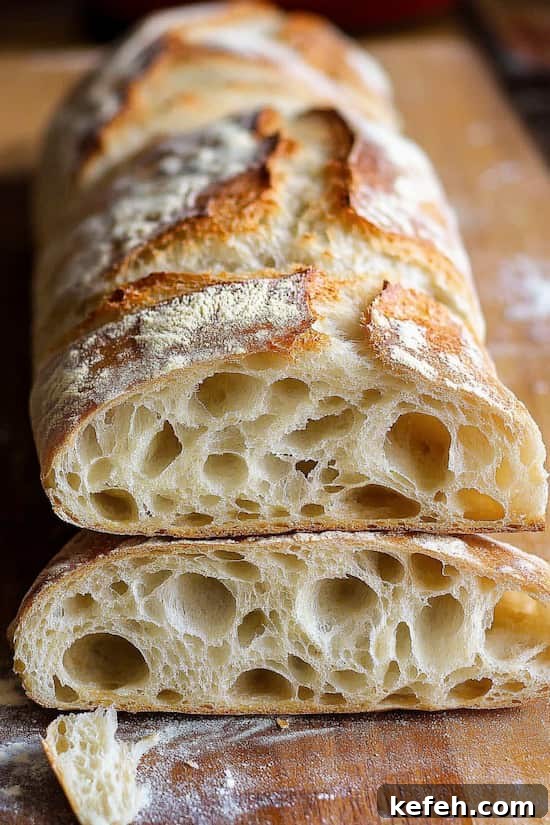
Homemade bread in under three hours? Yes—this quick ciabatta delivers classic results without the overnight wait. Traditional ciabatta relies on a long, slow fermentation to develop its open crumb and deep flavor, but this faster method produces a crisp crust, tender interior, and large air pockets in a fraction of the time.
The first time I tried this shortcut I expected a compromise, but the loaf surprised me: a crackling crust, an airy, chewy crumb, and bread gone by dinner. Since then it’s become my go-to when I want fresh bread without planning a day ahead.
Why I Love This Recipe
This ciabatta balances speed and quality. The dough stays high-hydration and intentionally sticky—key to that open crumb—while reducing rise time to about two hours. You can decide to bake after lunch and have bread on the table by dinner.
Reasons I keep making it:
- Fast and forgiving. Start and finish in an afternoon.
- Minimal ingredients. Just flour, water, yeast, salt, and oil—no eggs or butter.
- Crispy outside, chewy inside. The classic ciabatta contrast.
- Great for beginners. No kneading or precise shaping required.
It feels a bit like magic, but it’s really technique and a very wet dough. And it will fill your kitchen with a irresistible bakery aroma.
Ingredients
Five pantry staples:
- 3 cups (360g) all-purpose or bread flour
- 1 ¼ tsp salt
- 1 tsp instant yeast
- 1 cup (240ml) lukewarm water
- 1 tbsp olive oil (for greasing)
You can double the recipe for two loaves; it scales well and the dough behavior remains the same.
In a large bowl, whisk the flour, salt, and yeast together. Pour in the lukewarm water and stir until a shaggy, sticky dough forms—no kneading required. The dough should be rough and wet, almost like a thick batter.
Cover the bowl with a towel or plastic wrap and let the dough rest at room temperature for 1 hour. It should roughly double and look bubbly on top. If your kitchen is cool, allow an extra 10–15 minutes.
Fold and Rest Again
Generously flour your work surface and wet your hands. Gently turn the dough out and fold it over itself a few times to form a loose rectangle—be careful to preserve the air bubbles. Transfer the dough to a floured sheet of parchment on a baking tray, dust lightly with flour, cover loosely, and rest for 30 minutes while you preheat the oven.
Preheat your oven to 450°F (230°C). A baking stone or steel gives the best oven spring, but a regular baking sheet works fine.
Bake the Ciabatta Bread
Bake for 22 to 25 minutes, until the top is golden and the bottom sounds hollow when tapped. For extra crunch, create steam by spritzing water into the oven when the loaf goes in or by placing a pan of hot water on the lower rack.
Allow the bread to cool on a wire rack for at least 30 minutes before slicing. Waiting helps the crumb set; cutting too soon will compress those lovely holes.
Tips for Success
This dough should be sticky—don’t add extra flour out of habit. Keep your hands wet while handling to prevent sticking. Be gentle during folding to keep the air pockets intact, use parchment to transfer the loaf to the oven, and always let the loaf cool fully before slicing to avoid a gummy interior.
Simple ingredients and a light touch are the keys to great texture.
How to Serve It
Quick ciabatta is versatile: use it for paninis, slice and toast with garlic butter, or serve with soups, stews, and pastas. It makes excellent sandwiches with roasted vegetables or melted cheese. Thin slices are perfect for bruschetta, and a smear of ricotta and honey makes a delightful snack.
Leftovers freeze well—slice and store in a zip-top bag, then toast slices from frozen. To refresh a whole loaf, reheat at 350°F for 10 minutes to revive the crust. Stale ciabatta also makes great croutons: cube, toss with oil and herbs, and bake until golden.
My Final Verdict
This quicker ciabatta proves you don’t need an 18-hour plan to bake something bakery-worthy. With minimal effort and about three hours total, you can enjoy fresh, crusty bread that tastes like it took all day.
It’s the kind of recipe that makes you feel like a pro—even on your first try. I still appreciate slow rises when time allows, but this fast version reliably hits the spot and has earned a permanent place in my baking rotation.
Try it once and you’ll see why—there’s nothing like slicing into a warm loaf you made yourself and seeing that open, airy crumb.
Print
Homemade Ciabatta Bread Recipe
Author: Tomi
Prep Time: 15 minutes
Cook Time: 2 hours
Total Time: 2 hours 45 minutes
Yield: 1 medium loaf 1x
Category: Side Dish
Method: Baking
Cuisine: Italian
Diet: Vegetarian
Description
There’s something deeply satisfying about baking your own ciabatta—rustic, golden, full of large airy holes and that chewy texture that feels artisan even on an ordinary day.
Ingredients
Scale
3 cups (360g) all-purpose or bread flour
1 ¼ tsp salt
1 tsp instant yeast
1 cup (240ml) lukewarm water
1 tbsp olive oil (for greasing)
Instructions
Make the Dough
In a large bowl, whisk the flour, salt, and yeast. Add the lukewarm water and stir until a soft, sticky dough forms. It should look rough but uniform. Cover with a damp towel or plastic wrap.
First Rise (1 hour)
Let the dough rise at room temperature about 1 hour, until doubled and bubbly.
Fold and Rest Again (30 minutes)
Lightly flour your surface, turn out the dough, and fold it over itself 2–3 times to form a loose rectangle. Transfer to floured parchment on a baking sheet, dust the top, cover loosely, and let rise 30 minutes.
Preheat and Bake
Preheat oven to 450°F (230°C). Bake 22–25 minutes, until golden and hollow-sounding when tapped on the bottom.
Cool and Serve
Cool completely on a wire rack before slicing to preserve texture.
Notes
The dough will be very wet—avoid adding extra flour.
Wet your hands when handling to reduce sticking.
Be gentle to preserve air bubbles.
Allow the loaf to cool fully for best texture.