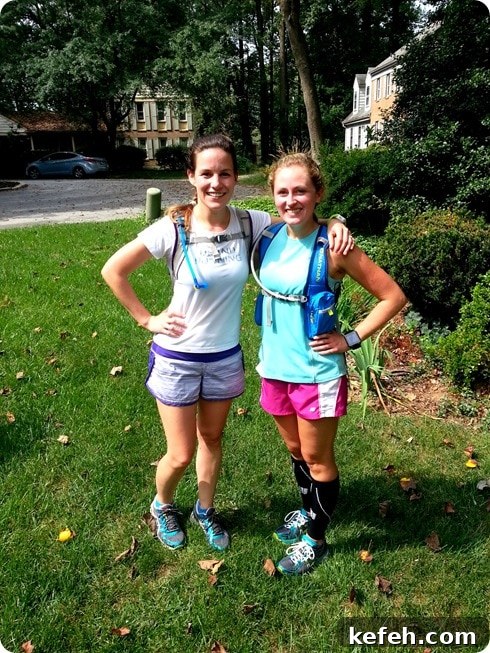
My marathon training partner Kathleen and I hit a new distance milestone this week: 16 miles.
This run felt like the first time we truly trained for a full marathon instead of a half. There was that moment near the end when we realized we’d still have ten miles to go in a real race and both of us thought, “Wow — this is going to be intense.”
The run was definitely challenging — 16 miles is a long way — but we felt steady for most of it and enjoyed a beautiful route.
Kathleen is staying with family in Columbia, MD while her bathroom is being renovated, and she works in the city several days a week. Since she has Thursdays off, I drove up early to run with her and enjoy a change of scenery.
I was up at 6 a.m., out the door by 6:30, and we started running around Columbia just before 8. It was humid but overcast, which made the conditions more comfortable than full sun.
Kathleen planned a lovely route that wove through wooded trails, neighborhoods, and around a scenic lake, which made the miles more enjoyable.
For pre-run fuel I had my usual Ezekiel toast with almond butter and jam, plus a quick shot of espresso since I wouldn’t be starting immediately. I skipped a milky latte to avoid stomach upset.
During the run we carried a mix of fuel: margarita shot bloks for a sweet, salty boost and Cytomax energy drops. I transferred the bloks into a small baggie for easy access.
The shot bloks are great for long, sweaty runs because they contain salt and taste good. The downside is that chewing while breathing hard is awkward, so we stopped every few miles to eat one or two.
For hydration I used a Nathan HPL 020 Race Vest that the company sent me to try. I normally prefer a CamelBak Hydrobak, but for marathon training I wanted a vest that carried more water and had front pockets to stash a camera, gels, and my phone.
The Nathan vest was comfortable and compact on my smaller frame, didn’t chafe, and its smaller front pockets fit my point-and-shoot camera and gels perfectly. It holds 2 liters of water, and I filled it completely for the run. I finished the last of the water right at the end, so for longer distances I’ll plan a water stop.
I also wore my CEP compression sleeves for the first time in a few months; they normally help on long runs but add warmth, so I usually reserve them for cooler conditions or recovery. For this 16-mile effort, compression felt right.
Kathleen and I talked for most of the run, which made the miles fly by. We did get quiet in the final miles, though — fatigue set in and the hills didn’t help.
We were thrilled to finish. The marathon exertion is a different kind of tired than a half marathon — even at 16 miles you notice a distinct weariness. With each long run I gain more respect for marathoners; this distance takes a lot of physical and mental grit.
We had a technical fail with our watches: both timed out around mile nine after we stopped to refill and refuel, so neither showed a clean 16-mile split. Instead we ended up with one 9.2-mile and one 6.8-mile record. It was annoying not to see a single “16 miles” on our GPS, but we had a decent finish time of about 2:36, which roughly equates to a 9:42 per mile pace. We did slow down in the last miles.
By the end my knee felt a bit stiff and my left arch felt tight, so I’ve been rolling my foot on a tennis ball, icing my knee, and doing hip-strengthening exercises. Once we consistently run beyond 16 miles I’ll likely add ice baths to recovery, too.
Any tips from experienced marathoners as we ramp up mileage? Next week is a step-down week because we’re running the Parks Half Marathon, and then the following week we’ll build to 17 miles. Excited and nervous!
Have a great weekend — Matt and I are squeezing in one last beach trip for the holiday, so I’ll share our adventures when I’m back on Tuesday. Until then!